Does 3I/ATLAS Generate Its Own Light?
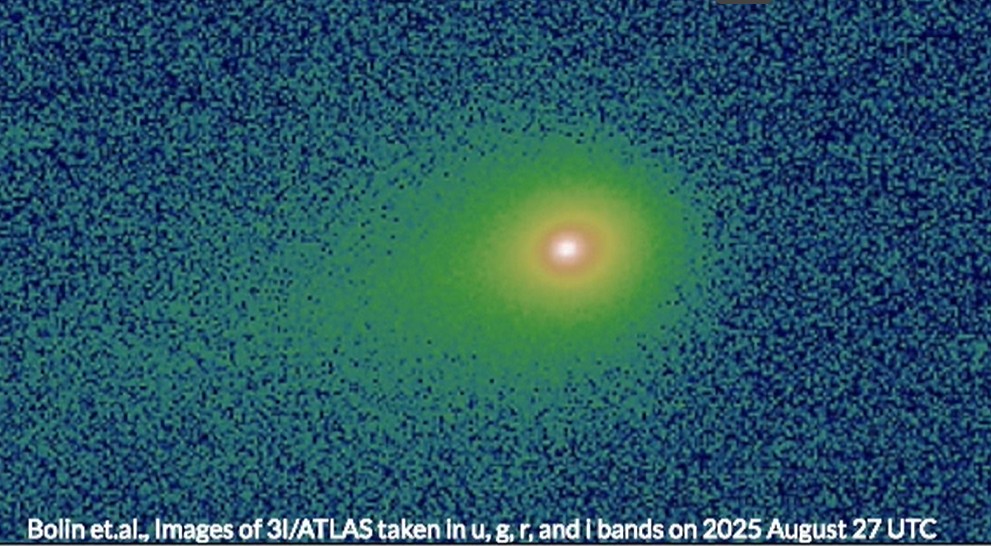
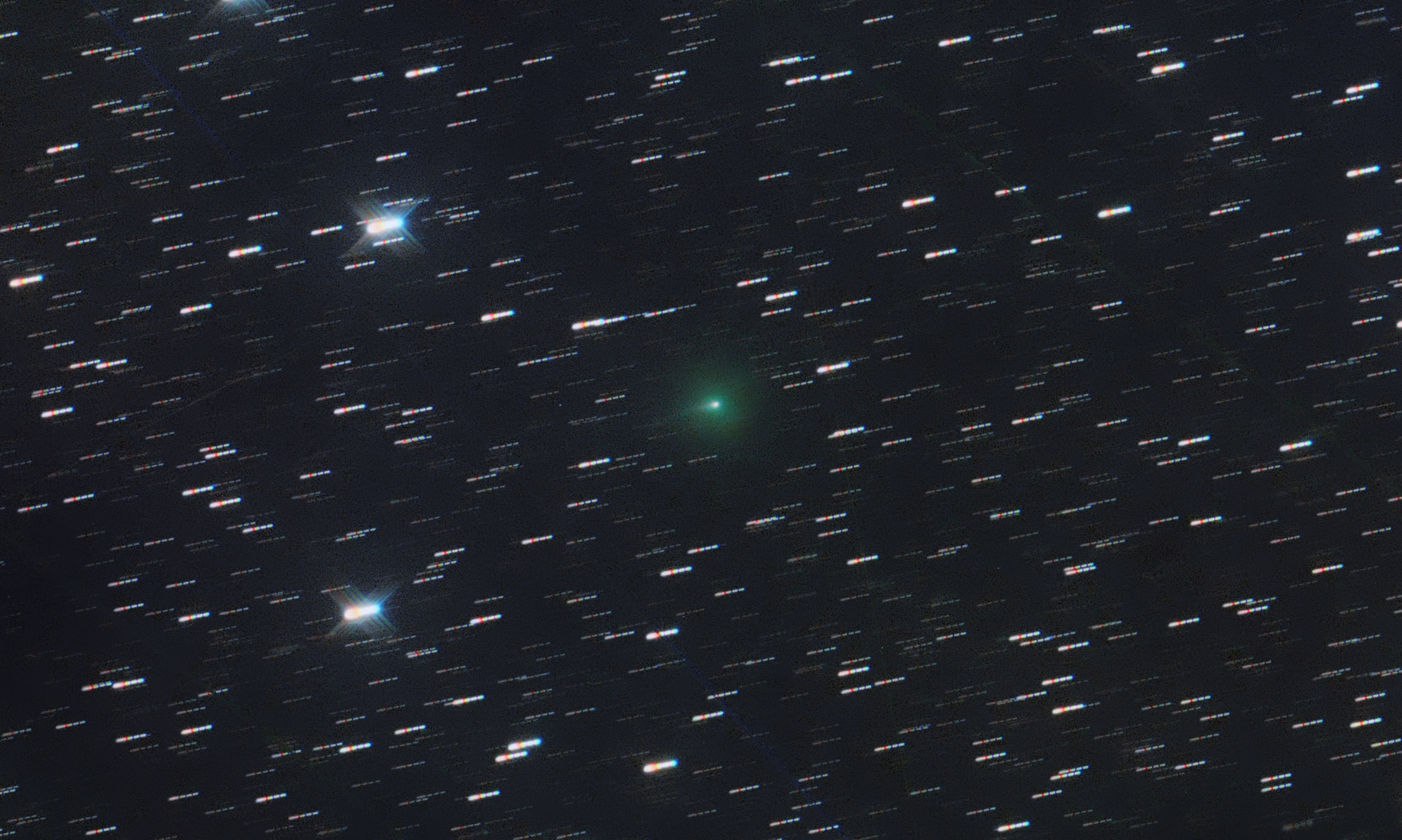
The best image we have so far of the new interstellar object, 3I/ATLAS, was obtained by the Hubble Space Telescope on July 21, 2025. The image shows a glow of light, likely from a coma, ahead of the motion of 3I/ATLAS towards the Sun. There is no evidence for a bright cometary tail in the opposite direction. This glow was interpreted as evaporation of dust from the Sun-facing side of 3I/ATLAS.
Figure 3 of the analysis paper (accessible here) shows a steep surface brightness profile of the glow with a projected power-law slope of -3, which implies a three-dimensional emissivity profile with a radial power-law slope of -4. Such a slope is steeper than observed in solar system comets. Together with my brilliant colleague, Eric Keto, we realized that the observed slope of -4 is consistent with an alternative model in which the dust outflow around 3I/ATLAS is illuminated by a central source. This model naturally accounts for the steep brightness profile, since the outflow density slope of -2 is accompanied by the radial decline of the illuminating radiation flux with an additional declining slope of -2.
First, I calculated that the luminosity of 3I/ATLAS needs to be of order 10 gigawatt. Second, I realized that the steep brightness profile around 3I/ATLAS implies that the nucleus dominates the observed light. This must hold irrespective of the origin of the light. In other words, the nucleus dominates over the emission from the glow around it.
The illumination by sunlight cannot explain the steep 1/R⁴ profile of scattered light, where R is the radial distance from the nucleus. This is because a steady dust outflow develops a 1/R² profile which scatters sunlight within the same emissivity profile. Sunlight would dominate the illumination in this model because a rocky nucleus would reflect only a small fraction of the solar intensity from a much smaller area than the 10,000-kilometer region resolved in the Hubble Space Telescope image. Another possibility for the steep brightness profile is that the scattering halo is made of icy particles that get evaporated as they move towards the Sun from the warm Sun-facing side of 3I/ATLAS. This would explain why there is no tail of these scattering particles. The required evaporation time must be of order 10 minutes but it is unclear whether this would lead to the observed 1/R⁴ brightness profile.
The simplest interpretation is that the nucleus of 3I/ATLAS produces most of the light. I calculated that the nucleus cannot be a thermal emitter with an effective surface temperature below 1000 degrees Kelvin or else its peak emission wavelength would have been longer than 3 micrometers with an exponential cutoff at shorter wavelengths, incompatible with the data. At higher effective temperatures, the required luminosity of 3I/ATLAS can be obtained from a source diameter smaller than 100 meters. A compact bright emitter would make 3I/ATLAS of comparable size to the previous interstellar objects 1I/`Oumuamua or 2I/Borisov, making more sense than the 20-kilometer size inferred in the model where it reflects sunlight.
What could constitute the required light source?
I first calculated that a primordial black hole with a Hawking temperature of 1,000 degrees Kelvin would produce only 20 nanowatts of power, clearly insufficient to power 3I/ATLAS. A natural nuclear source could be a rare fragment from the core of a nearby supernova that is rich in radioactive material. This possibility is highly unlikely, given the scarce reservoir of radioactive elements in interstellar space.
Alternatively, 3I/ATLAS could be a spacecraft powered by nuclear energy, and the dust emitted from its frontal surface might be from dirt that accumulated on its surface during its interstellar travel. This cannot be ruled out, but requires better evidence to be viable.
Insisting on 3I/ATLAS being a natural object, one might consider the hypothetical case of an object heated by friction on an ambient medium. In this case, the momentum flux of the dust flowing out of the object must exceed the momentum flux of the ambient medium in the rest frame of the object, the so-called ambient ram pressure. Otherwise, the dust outflow would be suppressed by the ambient medium. What does this condition boil to?
Given the mass loss rate (6–60 kilograms per second) and ejection speed of dust (20–2 kilometers per second) that were inferred from the Hubble Space Telescope image, I calculated that this model is marginally ruled-out. In addition, the required ambient medium density is larger by many orders of magnitude than the mass density of the zodiacal gas and dust through which 3I/ATLAS is traveling as it traverses the main asteroid belt.
This leaves us with the interpretation of the brightness profile around 3I/ATLAS as originating from a central light source. Its potential technological origin is supported by its fine-tuned trajectory (as visualized here and discussed here).
The new interstellar object 3I/ATLAS is expected to pass within a distance of 28.96 (+/-0.06) million kilometers from Mars on October 3, 2025. This would offer an excellent opportunity to observe 3I/ATLAS with the HiRISE camera near Mars, one of six instruments onboard the Mars Reconnaissance Orbiter.
This morning, I encouraged the HiRISE team to use their camera during the first week of October 2025 in order to gather new data on 3I/ATLAS. They responded favorably. It would be challenging to observe 3I/ATLAS from Earth around the same time because of the proximity of 3I/ATLAS in our sky to the direction of the Sun. The more data we collect on 3I/ATLAS, the closer we will get to understanding its nature.
First, I calculated that the luminosity of 3I/ATLAS needs to be of order 10 gigawatt. Second, I realized that the steep brightness profile around 3I/ATLAS implies that the nucleus dominates the observed light. This must hold irrespective of the origin of the light. In other words, the nucleus dominates over the emission from the glow around it.
The illumination by sunlight cannot explain the steep 1/R⁴ profile of scattered light, where R is the radial distance from the nucleus. This is because a steady dust outflow develops a 1/R² profile which scatters sunlight within the same emissivity profile. Sunlight would dominate the illumination in this model because a rocky nucleus would reflect only a small fraction of the solar intensity from a much smaller area than the 10,000-kilometer region resolved in the Hubble Space Telescope image. Another possibility for the steep brightness profile is that the scattering halo is made of icy particles that get evaporated as they move towards the Sun from the warm Sun-facing side of 3I/ATLAS. This would explain why there is no tail of these scattering particles. The required evaporation time must be of order 10 minutes but it is unclear whether this would lead to the observed 1/R⁴ brightness profile.
The simplest interpretation is that the nucleus of 3I/ATLAS produces most of the light. I calculated that the nucleus cannot be a thermal emitter with an effective surface temperature below 1000 degrees Kelvin or else its peak emission wavelength would have been longer than 3 micrometers with an exponential cutoff at shorter wavelengths, incompatible with the data. At higher effective temperatures, the required luminosity of 3I/ATLAS can be obtained from a source diameter smaller than 100 meters. A compact bright emitter would make 3I/ATLAS of comparable size to the previous interstellar objects 1I/`Oumuamua or 2I/Borisov, making more sense than the 20-kilometer size inferred in the model where it reflects sunlight.
What could constitute the required light source?
I first calculated that a primordial black hole with a Hawking temperature of 1,000 degrees Kelvin would produce only 20 nanowatts of power, clearly insufficient to power 3I/ATLAS. A natural nuclear source could be a rare fragment from the core of a nearby supernova that is rich in radioactive material. This possibility is highly unlikely, given the scarce reservoir of radioactive elements in interstellar space.
Alternatively, 3I/ATLAS could be a spacecraft powered by nuclear energy, and the dust emitted from its frontal surface might be from dirt that accumulated on its surface during its interstellar travel. This cannot be ruled out, but requires better evidence to be viable.
Insisting on 3I/ATLAS being a natural object, one might consider the hypothetical case of an object heated by friction on an ambient medium. In this case, the momentum flux of the dust flowing out of the object must exceed the momentum flux of the ambient medium in the rest frame of the object, the so-called ambient ram pressure. Otherwise, the dust outflow would be suppressed by the ambient medium. What does this condition boil to?
Given the mass loss rate (6–60 kilograms per second) and ejection speed of dust (20–2 kilometers per second) that were inferred from the Hubble Space Telescope image, I calculated that this model is marginally ruled-out. In addition, the required ambient medium density is larger by many orders of magnitude than the mass density of the zodiacal gas and dust through which 3I/ATLAS is traveling as it traverses the main asteroid belt.
This leaves us with the interpretation of the brightness profile around 3I/ATLAS as originating from a central light source. Its potential technological origin is supported by its fine-tuned trajectory (as visualized here and discussed here).
The new interstellar object 3I/ATLAS is expected to pass within a distance of 28.96 (+/-0.06) million kilometers from Mars on October 3, 2025. This would offer an excellent opportunity to observe 3I/ATLAS with the HiRISE camera near Mars, one of six instruments onboard the Mars Reconnaissance Orbiter. This morning, I encouraged the HiRISE team to use their camera during the first week of October 2025 in order to gather new data on 3I/ATLAS. They responded favorably. It would be challenging to observe 3I/ATLAS from Earth around the same time because of the proximity of 3I/ATLAS in our sky to the direction of the Sun. The more data we collect on 3I/ATLAS, the closer we will get to understanding its nature.